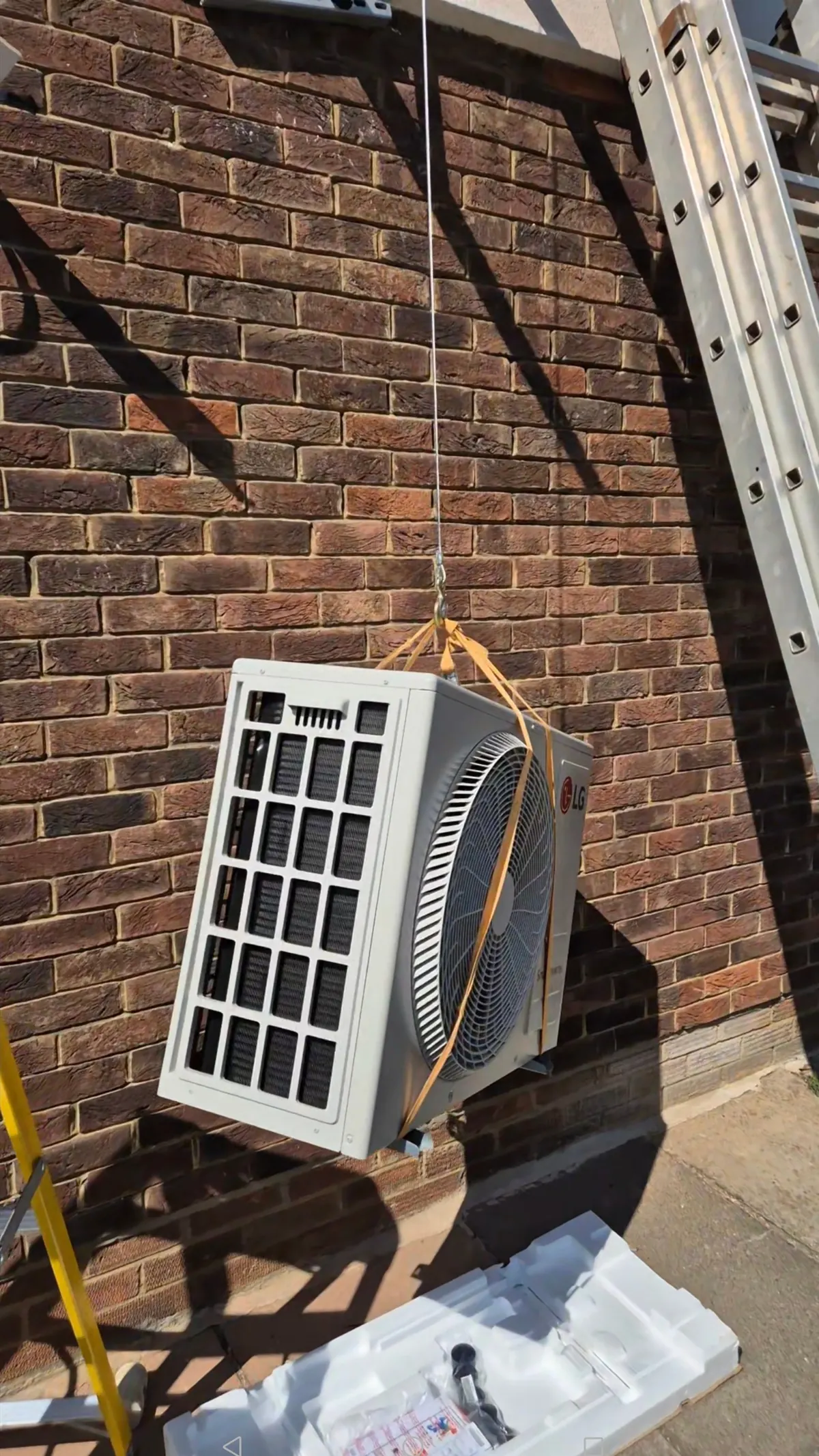
Air conditioning in a
leasehold flat
It is usually possible, and it is usually done in the wrong order. You need the freeholder's written consent and planning permission, they are separate, and one of them should always come first. Here is the sequence that works.
- Freeholder consent first, planning second, installer third
- We supply the licence pack the managing agent asks for, free
- Sound data and a marked-up drawing included
- We will tell you if your building is a genuine no
- Electro Heating LimitedCompany 12609754, registered in England and Wales
- NICEIC and Gas Safe registeredHeld by the parent company
- MCS certifiedFor heat pump and solar work
- 10+ years in LondonSame engineers, same company
You can normally install air conditioning in a leasehold flat, but you need two things: the freeholder's written consent and planning permission from the council.
Flats are excluded from the permitted development rights that houses have, so the planning application is not optional. Get the freeholder's answer first, because there is no point paying for an application on a building that will not allow the unit.
The order to do it in
Most of the flat installations that go wrong go wrong because the steps were done in the wrong sequence, usually by paying an installer before asking the freeholder. This is the order that costs the least if the answer turns out to be no.
- Read your lease. Look for the alterations clause. Almost every lease restricts changes to the exterior, and many add that consent shall not be unreasonably withheld, which is a useful phrase to have on your side.
- Ask the freeholder or managing agent, in writing, what their process is. Not whether you can have it. What the process and the fee are. That question gets answered; the other one gets ignored.
- Get a free survey and the licence pack. We identify the unit position, specify the machine, produce the drawing and the sound data, and give you the pack to submit. No charge and no commitment.
- Submit for consent and wait. Two to eight weeks is normal. A formal licence to alter takes longer.
- Apply for planning permission once you have consent in hand. Eight weeks in London, 258 pounds for a householder application.
- Book the install. Now, and not before.
What it costs, all in
| Item | Cost | Notes |
|---|---|---|
| Survey and licence pack | £0 | We do not charge for this |
| Freeholder or agent administration fee | £0 to £500 | Varies enormously between agents |
| Licence to alter, where required | £400 to £1,200 | Includes the freeholder's legal costs |
| Householder planning application | £258 | Fixed national fee in England |
| Installation, one bedroom unit | £1,900 to £2,900 | Flats often cost more, because access is harder |
| Total, typical | £2,500 to £4,800 | The spread is almost all freeholder fees |
What goes in the licence pack
Managing agents refuse applications for missing paperwork far more often than they refuse them on the merits. The pack we produce contains everything a reasonable agent asks for:
- A written description of the work and the method.
- The make, model and technical data for the outdoor unit, including the sound pressure level at one metre.
- A marked-up photograph or drawing showing the exact position of the unit, the pipe route, the core hole positions and the condensate termination.
- Our public liability insurance certificate.
- Confirmation of who makes good, and to what standard.
- A statement of how the unit will be removed and the fabric reinstated if you leave.
That last item resolves more applications than any of the others, because the freeholder's real worry is being left with holes in the wall in five years time.
Where the outdoor unit can actually go in a flat
| Position | Workable? | The catch |
|---|---|---|
| Balcony | Usually | Still an alteration, still needs consent. Watch the discharge direction |
| Flat roof above a top-floor flat | Often the best answer | Needs roof access rights and a load check |
| Rear light well | Sometimes | Sound reverberates in a light well, so the noise assessment is harder |
| Rear elevation wall bracket | Sometimes | Needs the freeholder to allow fixing into the structure |
| Communal garden or ground | Rarely | Usually communal property, so every leaseholder has an interest |
| Front elevation | Almost never | Refused on appearance, and blocked in conservation areas anyway |
| Window mounted | No | Fails on appearance, security and usually on the lease |
If the answer is genuinely no
Some buildings will not allow it. A mansion block with a uniform frontage, a listed building, or a freeholder with a blanket policy. If that is where you have landed, these are the honest alternatives, with their real drawbacks:
- A monobloc or portable unit. No outdoor unit, but the compressor is in the room so it is noisy, it needs a permanent vent, and it uses roughly twice the electricity for the same cooling.
- Mechanical ventilation with cooling. Works in some conversions, needs ductwork and ceiling depth that most flats do not have.
- Passive measures first. External shading, reflective film on south-facing glass, and proper night purge ventilation. Not glamorous, and in a top-floor flat with big windows they genuinely help.
We would rather tell you your building is a no and lose the job than take a deposit for something that will be refused.
Leasehold flat questions
Can I install air conditioning in a leasehold flat?
Usually yes, but you need two separate permissions and they are not interchangeable: the freeholder's written consent, because the outdoor unit alters the exterior of the building, and planning permission from the council, because flats are excluded from permitted development for air conditioning.
Get the freeholder's consent first. There is no point paying for a planning application on a building whose owner will not allow the unit at all.
What does the freeholder or managing agent need from me?
Normally a written description of the work, the make and model of the outdoor unit with its sound data, a drawing or marked-up photograph showing exactly where it will go and how the pipework will be routed, the installer's public liability insurance, and confirmation of who is responsible for making good.
We supply all of that as a licence pack at no charge, because a refused application because of a missing document wastes both our time.
How much does freeholder consent cost?
It varies a lot. Some freeholders charge nothing. Most managing agents charge an administration fee of 150 to 500 pounds, and some require a formal licence to alter drawn up by a solicitor, which typically runs from 400 to 1,200 pounds including the freeholder's legal costs.
Ask what the process and the fee are before you commission anything. It is a fair question and a reasonable agent will answer it in writing.
What if my lease says I cannot alter the exterior?
Nearly every lease says that. It does not mean the answer is no, it means you need consent. Many leases add that consent shall not be unreasonably withheld, which gives you a position to work from if the freeholder simply ignores you.
If the freeholder refuses outright and your lease contains that wording, a first-tier tribunal application is possible. It is slow and it is a bigger step than most people want to take for a bedroom unit, so it is worth exploring a different unit position first.
Are there systems that avoid needing an outdoor unit?
There are two, and both have real drawbacks that are worth knowing before you get excited. A monobloc or single-hose portable unit needs a permanent vent through a wall or window, is noisy because the compressor is in the room, and is much less efficient. A water-cooled or split-less wall unit still needs external grilles, which are still an alteration to the exterior.
For a top-floor flat with a flat roof above, or a flat with a balcony or a light well, a conventional split system is nearly always the better result. It is worth exhausting those options before settling for a portable.
Do I need permission if the unit goes on my own balcony?
Almost certainly yes. In most London leases the balcony is demised to you for use but the structure and the external appearance of the building remain the freeholder's, so putting a machine on it that is visible from outside is still an alteration to the exterior.
Planning permission is also still required, because the exclusion of flats from permitted development is about the building type, not about where on the building the unit sits.
Send us your building and we will tell you honestly
A photo of the rear elevation and the name of your managing agent is usually enough for us to say whether this is straightforward, difficult or genuinely not possible.