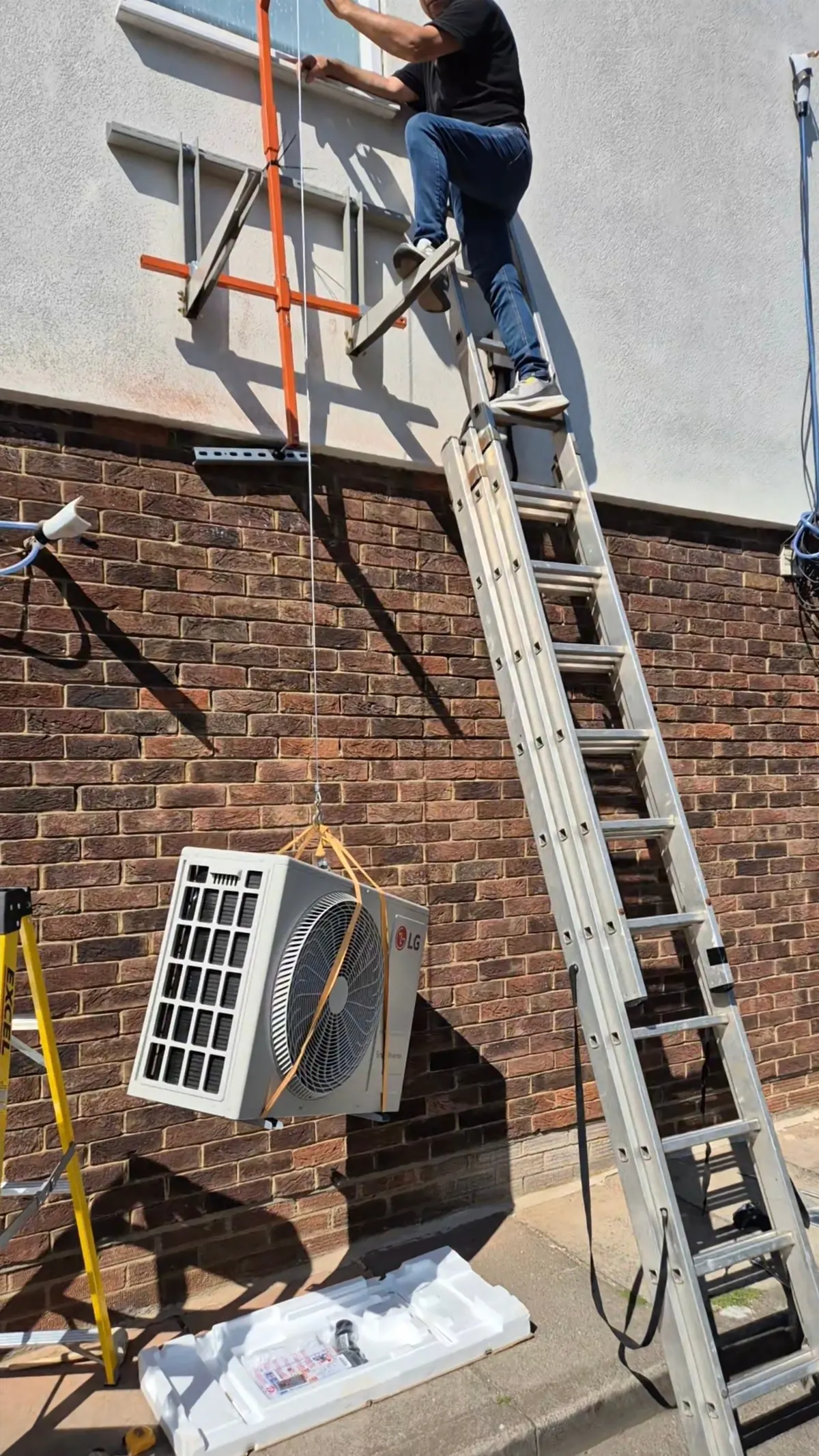
Air source heat pumps
London
Whole-house heating and hot water that replaces a gas boiler, with the 7,500 pound government grant taken off your invoice and 0 percent VAT on the install. MCS certified, and quoted from a real heat loss survey rather than a rule of thumb.
- 7,500 pounds Boiler Upgrade Scheme grant, handled by us
- 0 percent VAT on the whole installation
- MCS certified, so the grant and the warranty are valid
- Full room by room heat loss survey before we quote
Typical London three-bedroom house: 3,500 to 6,500 pounds after the grant.
- Electro Heating LimitedCompany 12609754, registered in England and Wales
- NICEIC and Gas Safe registeredHeld by the parent company
- MCS certifiedFor heat pump and solar work
- 10+ years in LondonSame engineers, same company
An air source heat pump for a typical London three-bedroom house costs 11,000 to 14,000 pounds installed, which becomes 3,500 to 6,500 pounds after the 7,500 pound Boiler Upgrade Scheme grant.
The grant is paid to the installer and deducted from your invoice, so you never fund it yourself. Installation carries 0 percent VAT. We handle the paperwork, including the MCS certificate and the DNO notification.
What it actually costs, by house
| Property | Before grant | After 7,500 pound grant | Typical unit |
|---|---|---|---|
| 1 to 2 bed flat or small terrace | £9,500 to £12,000 | £2,000 to £4,500 | 5kW to 7kW |
| 3 bed semi or terrace | £11,000 to £14,000 | £3,500 to £6,500 | 8kW to 9kW |
| 4 bed detached | £13,500 to £17,500 | £6,000 to £10,000 | 11kW to 12kW |
| Large or poorly insulated house | £17,000 to £24,000 | £9,500 to £16,500 | 14kW to 16kW |
Includes the heat pump, hot water cylinder, radiator upgrades identified by the survey, controls, all pipework and electrical work, commissioning, MCS certification and the grant application. 0 percent VAT applies. The exact number comes from the heat loss survey, which is free.
The one thing to be clear about before you read further
An air source heat pump is not air conditioning, and the two get confused constantly because both have a box outside.
| Air source heat pump | Air conditioning | |
|---|---|---|
| What it heats | Radiators, underfloor and your hot water | The air in one room |
| Does it cool? | No | Yes |
| Replaces your boiler? | Yes | No |
| Government grant | 7,500 pounds | None |
| VAT | 0 percent | 20 percent |
| Typical installed cost | £11,000 to £14,000 before grant | £1,750 to £3,500 per room |
| Install time | 2 to 3 days | 1 day per room |
If you want cooling in summer, that is air conditioning. If you want to stop burning gas and get 7,500 pounds towards it, that is a heat pump. Plenty of London houses end up with both: a heat pump doing the whole house heating and hot water, and one air conditioning unit in the bedroom that gets unbearable in July.
Do you qualify for the grant?
The Boiler Upgrade Scheme is open in England and Wales and pays a flat 7,500 pounds for an air source heat pump. Four conditions decide it:
| Condition | Detail |
|---|---|
| You own the property | Owner-occupiers, landlords and small business premises. Not new builds, not social housing |
| Valid EPC | In date, with no outstanding recommendation for loft or cavity wall insulation |
| Replacing fossil fuel | Gas, oil, LPG or electric. You cannot replace an existing heat pump with the grant |
| MCS certified installer | The installer applies for the grant, not you. We are certified through Electro Heating Limited |
The insulation condition is the one that stops most applications. If your EPC recommends loft or cavity wall insulation, that work has to be done first. We check the EPC before quoting so nobody finds out at the wrong moment.
What running one actually costs
A heat pump is a heat multiplier, not a heat maker. It moves heat that already exists in the outside air into your house, and the compressor is the only part using electricity, which is why it delivers roughly three to four units of heat for every unit of electricity across a UK heating season.
The comparison people find hardest to believe is this one: running a heat pump continuously through the October to April heating season typically costs about the same as, or less than, running a gas boiler in short bursts a few hours a day. Gentle continuous heat avoids the cold-start blast that wastes most of a boiler's output, and the house stays at a stable temperature instead of swinging.
The more of your house you actually heat, the better the heat pump looks. If you heat two rooms and wear a jumper, gas will stay cheaper.
What is in the install that people do not expect
- A room by room heat loss survey, which is what decides the unit size. Anyone quoting from your floor area alone is guessing.
- The DNO notification to your electricity network operator.
- Building Control compliance and the electrical installation certificate.
- A hot water cylinder, usually 180 to 250 litres, if you are coming off a combi boiler. This is the part people forget needs somewhere to live.
- MCS certification, which the grant depends on and which you need if you ever sell the house.
- Warranty registration and the first year's service booked.
Heat pump questions
How much does an air source heat pump cost in London?
A typical London three-bedroom house is 11,000 to 14,000 pounds installed before the grant, and 3,500 to 6,500 pounds after the 7,500 pound Boiler Upgrade Scheme grant is deducted. A one or two-bedroom flat or small terrace is often 9,500 to 12,000 pounds before grant.
The grant is paid to the installer and comes off your invoice, so you never have to fund it and claim it back. Heat pump installations also carry 0 percent VAT.
Do I qualify for the 7,500 pound grant?
You need to own the property in England or Wales, have a valid EPC with no outstanding recommendations for loft or cavity wall insulation, and be replacing a fossil fuel system such as gas, oil, LPG or electric heating. New builds and social housing are excluded.
The insulation condition is the one that catches people. If your EPC lists loft insulation as a recommendation, that has to be dealt with first. We check the EPC before quoting so it is not a surprise.
Do I need new radiators for a heat pump?
Some of them, usually not all. A heat pump runs at a lower flow temperature than a gas boiler, typically 45 to 50 degrees rather than 70, so each radiator gives out less heat and the ones that were already marginal need to be bigger.
In a typical London three-bedroom house that is three to five radiators, not fourteen. The heat loss survey tells us exactly which, and the answer goes in the quote rather than appearing as an extra during the install.
Will a heat pump work in an old Victorian house with solid walls?
Yes, and we fit them in exactly those houses. Solid walls mean a higher heat loss, which means a bigger unit and more radiator upgrades, so the install costs more and the running cost is higher than in an insulated new build. That is an honest trade-off, not a reason it cannot be done.
What decides it is the heat loss survey. If the numbers say the house needs insulation work first to make the heat pump sensible, we will say so rather than sell you a machine that will disappoint you.
Is an air source heat pump the same thing as air conditioning?
No, and this is the most common confusion in the whole subject. An air source heat pump is air-to-water: it heats water for your radiators, underfloor heating and hot water cylinder, it replaces your boiler, and it qualifies for the 7,500 pound grant. It does not cool your rooms.
Air conditioning is air-to-air: it blows cooled or heated air directly into a room, it does not touch your hot water, and it gets no grant. Many people want both, for different reasons, and we fit both.
How noisy is a heat pump outdoor unit?
Typically 40 to 50 decibels at one metre, which is about the level of a quiet conversation, and it is a low steady hum rather than the on-off of a boiler flue. Permitted development requires it to meet a noise limit at the nearest neighbouring window, assessed under MCS 020.
Where a garden is tight, the position and any acoustic screening are worked out on the survey, because that is far more effective at controlling noise than the unit choice.
Find out what your house actually needs
A free heat loss survey, a fixed price with the grant already deducted, and an honest answer if your property is not ready for one yet.